
Finding the right music for a video project, podcast, or commercial campaign sounds simple enough — until you’re deep in a licensing agreement trying to work out whether your documentary qualifies as a “broadcast” use or whether your client’s promotional video is covered under the plan you already paid for. Choosing a royalty free music library isn’t just a matter of taste; it’s a practical decision that affects your workflow, your budget, and in some cases, your legal standing.
The demand for background music among content creators, filmmakers, and businesses has grown considerably in recent years, and 2026 is no different. The platforms serving that demand have matured too, with stronger catalogs, smarter search tools, and more nuanced licensing structures. That’s both a good and a slightly overwhelming development. More options means more to evaluate.
This article exists to make choosing between royalty-free music sites easier. Each platform on this list was assessed across the same criteria: music quality and catalog depth, licensing clarity, search functionality, pricing structure, and overall usability. The goal is a comparison that helps you land on the right platform for the kind of work you actually do.
A note on who’s writing this: this guide is published by TuneReel, and TuneReel is listed first because it’s our own library. We’ve aimed to describe every other platform fairly, and we checked their plans and pricing on their own sites in October 2026. The remaining platforms are grouped from subscription libraries to free options, each labeled with what it does best.
Quick Comparison Table
| Library | Best For | Pricing | Unlimited Downloads | Lifetime Option | Single Track Licenses | Client Work | Commercial Use |
|---|---|---|---|---|---|---|---|
| TuneReel | Filmmakers and cinematic projects | Monthly / Annual / Lifetime / Single | ✓ | ✓ | ✓ | ✓ (Pro) | ✓ |
| Artlist | All-in-one creative platform | Monthly (Social license) / Annual | ✓ | ✗ | ✗ | ✓ (Pro license) | ✓ |
| Epidemic Sound | YouTubers and social creators | Monthly / Annual / Single | ✓ | ✗ | ✓ | ✓ (Pro & Business) | ✓ |
| Soundstripe | Teams and agencies | Monthly / Annual / Single | ✓ | ✗ | ✓ | ✓ (Pro & up) | ✓ |
| Musicbed | Premium commercial and branded work | Annual (payable monthly) / Single | ✓ | ✗ | ✓ | ✓ (Business & up) | ✓ |
| Audiio | Lifetime buyers | Monthly / Annual / Lifetime | ✓ | ✓ | ✗ | ✓ (Pro & Lifetime) | ✓ |
| Envato Elements | Mixed creative assets | Monthly / Annual | ✓ | ✗ | ✗ | ✓ | ✓ |
| PremiumBeat | Flexible track licensing | Monthly / Annual / Per Track | ✓ | ✗ | ✓ | ✓ (Standard & up) | ✓ |
| Motion Array | Video editors needing bundled assets | Monthly / Annual | ✓ | ✗ | ✗ | ✓ (agencies need Business) | ✓ |
| Tunetank | Budget-conscious creators | Free / Monthly / Annual / Single | ✓ (paid plans) | ✗ | ✓ | ✓ (Max plan) | ✓ |
| Pixabay Music | Free use with basic needs | Free | ✓ | ✗ | ✗ | ✓ (watch for Content ID) | ✓ |
| YouTube Audio Library | Beginner YouTubers | Free | ✓ | ✗ | ✗ | ✗ | Limited |
Plans and prices checked in October 2026. Platforms change their pricing often, so confirm on each site before buying.
What Makes a Great Royalty Free Music Site?
Before diving into individual platforms, it’s worth understanding what separates an excellent music library from a merely adequate one. The differences are meaningful, and they compound over time the more you use a platform.
Music Quality
The most fundamental consideration is whether the music actually sounds good. That might seem obvious, but catalog quality varies enormously across platforms. Some libraries are genuinely impressive — professionally produced tracks with high-quality audio that hold up alongside commercial releases. Others are inconsistent, with pockets of strong material surrounded by filler that sounds like it was assembled quickly to pad out the catalog.
Two factors contribute heavily to quality: whether the tracks are produced by real musicians, and whether production standards are applied consistently across the catalog. AI-generated music has entered this space, and while the technology is improving rapidly, the results remain noticeably different from music made by people who understand arrangement, dynamics, and emotional arc. The best platforms are transparent about what’s in their catalog and maintain consistent standards regardless of genre.
Variety of Genres
A music library’s usefulness scales with its range. Creators work across wildly different contexts — a cinematic score for a short film has almost nothing in common with upbeat corporate background music for a product explainer. The strongest platforms cover a wide range of styles comfortably:
- Cinematic — Epic orchestral builds, tension cues, emotional swells
- Corporate — Clean, motivational, professional
- Pop — Contemporary hooks and radio-friendly arrangements
- Rock — From indie to hard rock and everything between
- Hip-Hop — Beats, trap, boom bap, lo-fi rap adjacent
- Lo-fi — Chill study beats, relaxed coffee shop vibes
- Electronic — Synth-driven, dance, ambient electronic
- Jazz — Smooth, bebop, swing, contemporary
- Ambient — Atmospheric, soundscape-driven, minimal
- Acoustic — Stripped-back guitar, folk, singer-songwriter adjacent
- Orchestral — Classical arrangements, chamber music, full orchestras
A library that does all of these well — rather than specializing deeply in one or two — is genuinely more useful to most creators.
Licensing Simplicity
Music licensing is where many creators run into trouble. The terms matter as much as the music itself. A strong library offers clear, readable licenses that cover:
- Commercial licensing — Using music in business videos and content that promotes a product or service
- YouTube monetization — Permission to earn ad revenue on monetized YouTube videos
- Client work — Covering projects made for paying clients, not just personal use
- Social media — Instagram Reels, TikTok, Facebook, and other social media platforms
- Broadcast — Television, radio, and streaming services
- Games — Music embedded in interactive applications
- Podcasts — Spoken-word shows distributed across podcast platforms
The key quality to look for here is clarity. Licenses that require extensive interpretation to understand create risk for the people using them.
Search Features
A catalog of 500,000 tracks is only useful if you can find what you’re looking for quickly. The best platforms offer multiple search dimensions:
- Mood filters — Happy, melancholic, tense, uplifting, mysterious
- Genre filters — Narrowing by musical style
- BPM — Matching music to video pacing
- Instruments — Searching by specific instrument presence
- Vocals — Filtering for instrumental-only or vocal tracks
- Similar songs — Finding more of what’s already working
- AI search — Describing what you need in natural language
Search quality often determines how long it takes to find usable music. Even a great catalog becomes frustrating if the discovery tools aren’t up to the task.
Pricing
Music libraries generally fall into four pricing models:
- Monthly subscriptions — Lower commitment, higher per-month cost
- Annual subscriptions — Better value for regular users, paid upfront or monthly
- Lifetime memberships — One-time payment, unlimited ongoing access
- Single-track licenses — Pay per track, no ongoing commitment
Each model suits different creators differently. The platforms that offer multiple options tend to serve a broader range of users more effectively. Whatever the model, check for hidden fees: per-seat charges, separate client licenses, or upgrades for broadcast use.
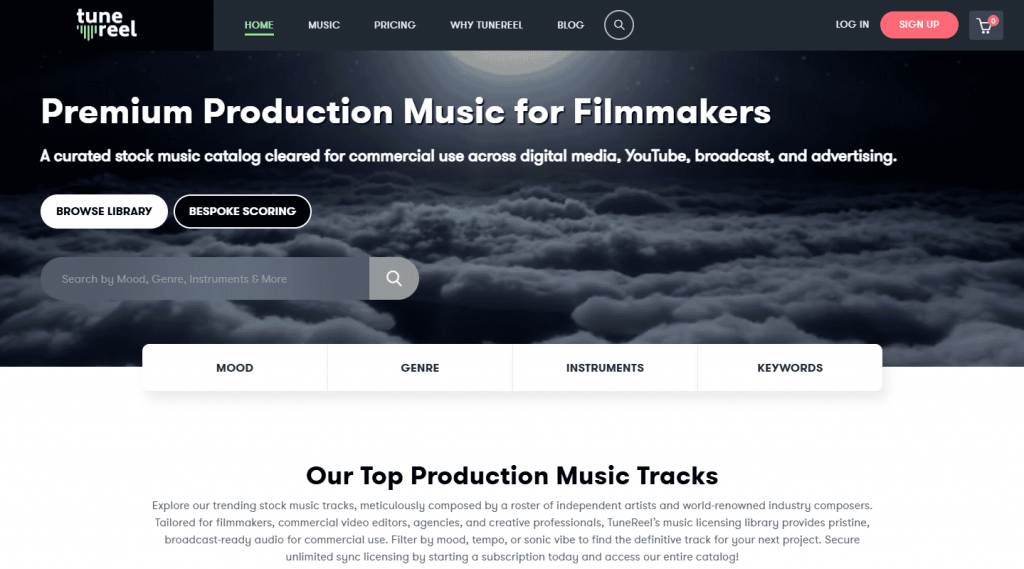
1. TuneReel — Best for Filmmakers and Cinematic Projects
Why We Picked It
Most music libraries are built around a primary use case: some for high-volume YouTube and social content, others for agencies or all-in-one creative toolkits. TuneReel is built for filmmakers. Its catalog leans toward cinematic, film-score-style music, and its licensing is organized around individual productions, which is how films are made and cleared.
It’s a strong fit for:
- Documentary filmmakers scoring non-fiction stories
- Independent and short filmmakers preparing for festivals and online release
- Wedding filmmakers needing emotional, cinematic music for client films
- Commercial and corporate video producers working for clients
- Podcast creators looking for clean intros, outros, and background beds
- Freelancers and small studios who want client coverage at a modest price
- Online advertisers running digital campaigns
- Course creators building educational video content
That focus shows in the details: licenses that document exactly which track was cleared for which production, and pricing that leaves room in an indie budget.
Strengths
Cinematic, Film-Score-Style Catalog
TuneReel’s catalog of about 6,900 tracks, with music from composers and independent artists, is curated rather than vast, with particular depth in cinematic, orchestral, ambient and emotional underscore, alongside corporate, acoustic, jazz, electronic and hip-hop. The aim is consistent production quality across genres rather than raw catalog size. If you need tens of thousands of tracks for daily social content, a larger library will suit you better; if you need music that sits well under picture, this is where TuneReel is strongest.
Search Built for Finding the Right Cue
TuneReel’s search combines an AI chat, where you describe the scene or feel you’re after in plain language, with filters for mood, genre, project type, keywords, featured instruments, key and BPM. A “Similar to” option finds more tracks like one that’s already working, and favorite and dislike buttons help narrow a shortlist.
Licensing Built Around Productions
Each license covers a specific production and lasts in perpetuity. You add a project title when you license a track, so every film or video has its own license on record — useful when a distributor, broadcaster or insurer asks for your music clearances. Covered uses include:
- Personal and hobby projects
- Commercial projects and paid work (Pro)
- Content created for clients (Pro)
- Social media, including short-form platforms
- Podcasts
- Film festivals, independent films and documentaries (Pro covers budgets up to $100,000)
- Online advertising and digital campaigns (Pro)
Memberships don’t cover TV or radio broadcast, VOD/OTT streaming, or theatrical release. Those uses, and productions above the Pro budget limit, are covered by a Universal license, priced on request.
Pricing Options
TuneReel offers four ways to pay — monthly, annual, lifetime or per track — and its prices are among the lowest in this comparison for the coverage you get:
- Basic Monthly at $9.99/month — For personal projects, with monetization for channels and podcasts under 10,000 subscribers at the time of licensing. Unlimited downloads.
- Pro Monthly at $19.99/month — Client work, commercial use and channels of any size, with unlimited downloads and Extended licenses. Covers organizations of up to 100 people with a video team of up to 3.
- Basic Annual at $89/year ($7.42/month) — The same coverage as Basic Monthly at a lower monthly cost.
- Pro Annual at $159/year ($13.25/month) — The same coverage as Pro Monthly, and the lowest-priced paid plan covering client work in this comparison.
- Lifetime Deal, currently $249 (one-time payment) — No recurring fees. Unlimited downloads with Extended licenses.
- Single-track licenses — Standard at $5/track (personal use, under 10,000 subscribers) and Extended at $15/track (business and client work). A Universal license for broadcast, streaming and theatrical use is available on request.
Having subscriptions, single tracks and a lifetime plan side by side means a filmmaker licensing music for one documentary doesn’t need a subscription, while a busy editor can skip recurring costs altogether. For comparison, client-work plans elsewhere in this guide start at about $180 a year and run well above that, and single-track commercial licenses from about $59 to $199. The trade-off is a smaller catalog than the biggest platforms and no sound effects library. Full plan details are on TuneReel’s pricing page.
Best For
- Documentary and independent filmmakers
- Short filmmakers and film students (TuneReel offers a free academic plan for film students)
- Wedding filmmakers
- Freelancers and small studios doing client work
- Commercial and corporate video producers
- Podcast creators
Pros
- Cinematic, film-score-style catalog suited to narrative and documentary work
- Lowest-priced paid client-work plan in this comparison ($159/year)
- AI chat search plus detailed filters and “Similar to”
- Per-production licenses that document each film’s music clearance
- Single-track licenses from $5 for personal use and $15 for commercial and client work
- Lifetime option with no recurring fees
- Money-back guarantee: if you haven’t licensed a single track, you receive a full refund
Cons
- Smaller catalog (about 6,900 tracks) than the largest platforms
- No sound effects library
- Memberships don’t cover broadcast, streaming or theatrical release; those need a Universal license
- Basic plans are limited to channels and podcasts under 10,000 subscribers
- Pro covers a video team of up to 3; larger video teams need a custom quote
- Each license asks for a project title, an extra step for creators publishing many videos a day

2. Artlist
Overview
Artlist launched in 2016 and built a strong reputation among independent filmmakers and commercial video producers. It has since grown into an all-in-one creative platform, offering music and sound effects alongside stock footage, templates, plugins and AI generation tools.
Strengths
Artlist’s catalog leans toward high-quality, emotionally resonant tracks — the kind of music that works well in cinematic and narrative contexts. The curation is noticeably intentional, and the wider platform means creators can source footage, templates and music in one place.
Licensing on Artlist is clear and covers most standard commercial uses. Its Pro license covers eligible client work; creative agencies and companies with more than 50 employees need a Business license.
Weaknesses
Monthly billing is available on the entry-level Music & SFX plan with a Social license, but plans with the Pro license, which covers client work, are billed annually. There are no single-track purchase options at any tier, which limits its usefulness for low-volume users.
Best For
Creators who want music, sound effects, footage, templates and AI tools in a single subscription, and filmmakers who value a polished cinematic catalog.
Pricing
Monthly billing with a Social license; annual billing for the Pro license and the Max plans. No lifetime membership, no single-track purchases.
3. Epidemic Sound
Overview
Epidemic Sound is one of the most widely used music libraries in the creator economy. Its catalog is large, its brand recognition is high, and it has become particularly well-associated with the YouTube and social media creator space.
Music Catalog
The catalog spans a wide range of genres and moods, with particular depth in the contemporary pop, lo-fi, and electronic categories that dominate short-form and YouTube content. Tracks are tagged extensively, and the search tools are strong.
Sound Effects
Epidemic Sound includes a substantial library of sound effects alongside its music catalog — a useful addition for video editors who’d otherwise need a separate source for sfx.
Licensing
Epidemic Sound’s licensing is tiered. The Creator plan covers personal channels, while the Pro and Business plans cover client work and commercial content, with higher tiers adding broadcast and wider distribution. Epidemic Sound also sells single-track licenses, priced by use, from personal social content up to commercial and client work.
Pros
- Large, well-tagged catalog
- Strong search and discovery tools
- Sound effects included
- YouTube Content ID system means tracks are whitelisted for monetization
- Widely recognized in the creator community
Cons
- Client work requires the Pro plan or higher
- No lifetime membership option
- Annual subscription can feel expensive for lower-volume creators
4. Soundstripe
Overview
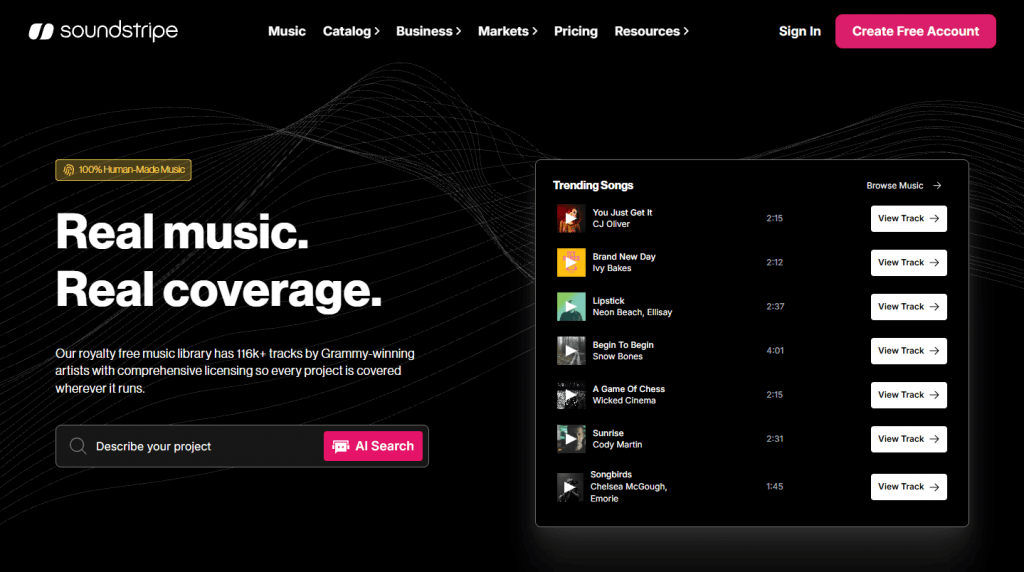
Soundstripe is a subscription-based music library with a well-organized catalog and a clean user experience. It’s built with professional content teams and agencies in mind, rather than purely individual creators.
Standout Features
Soundstripe’s most notable strength is its transparency around licensing. The platform provides clear documentation on what’s covered, which is particularly useful for teams where multiple people need to understand the rules. The platform also offers collaboration features and licensing documentation tools that make managing music across a team or agency considerably easier.
Single-use licenses are available for individual tracks across multiple tiers — Personal, Digital, Expanded, and All Media — starting from around $49 per track. This gives low-volume users a way to access the catalog without committing to a subscription.
The catalog is large, consistently produced and well-organized by genre, mood, and use case.
Pricing
Monthly and annual subscription options are available, as well as single-track licensing. No lifetime option.
Pros
- Strong licensing transparency and documentation
- Useful collaboration and team management features
- Consistent catalog quality
- Good search and filtering tools
- Single-track licensing available
Cons
- Client coverage starts on the Pro plan, and agencies and brands need the Enterprise plan
- No lifetime option
- Less suited to individual low-volume creators who want unlimited access
5. Musicbed
Why Filmmakers Love It
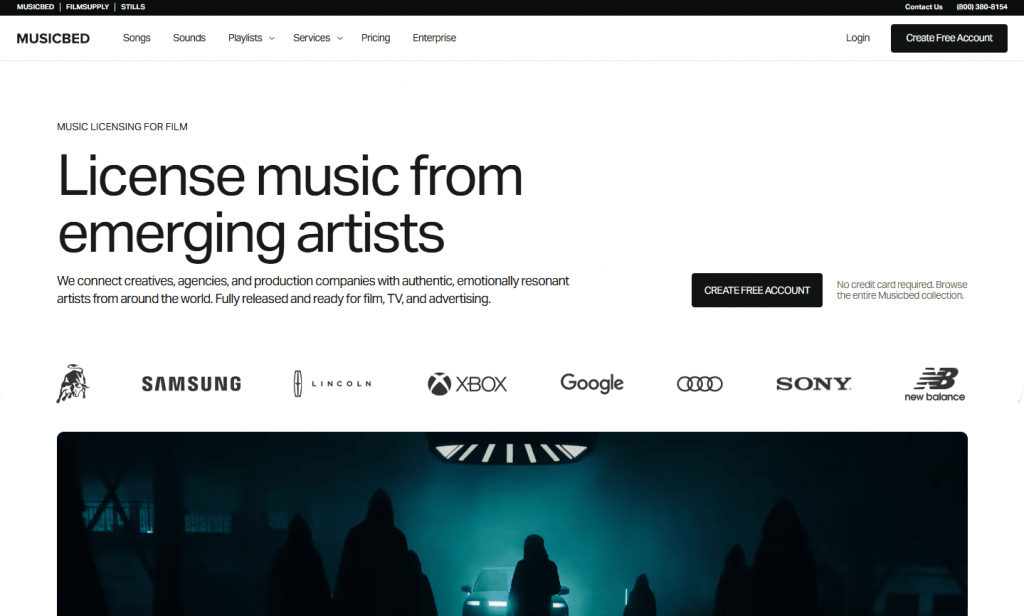
Musicbed has carved out a clear identity: it’s a premium library aimed at filmmakers and high-end commercial producers. The catalog reflects that positioning — it skews cinematic, emotional, and polished, with a notable emphasis on independent artists and bands rather than library composers working anonymously.
That distinction matters to some creators. If the origin and artistic identity of the music you use is important to your work, Musicbed is worth exploring.
Licensing
Musicbed offers both subscription and single-track licensing options. The sync licenses are detailed and cover a range of professional use cases including commercial work, film festival submissions, and broadcast contexts. Reading the specific license for each use case is recommended, as different tiers cover different uses.
Premium Catalog
The catalog is selective rather than vast. Musicbed’s strength is curation — it doesn’t try to have the most tracks, it tries to have the best ones for its target use case. If you need music that sounds like it belongs in a major brand commercial or a festival film, Musicbed is one of the better options in the market.
Pros
- High-quality, curated catalog
- Strong cinematic and emotional range
- Subscription and single-track options available
- Respected by professional filmmakers and commercial producers
Cons
- Premium pricing makes it less accessible for smaller budgets
- Catalog breadth outside cinematic contexts is limited
- Not as versatile as broader libraries for non-film creators

6. Audiio
Lifetime Licensing
Audiio’s defining feature is its lifetime membership option — a one-time payment for unlimited ongoing access to the catalog. For creators who have found a library they’re satisfied with and who plan to produce content consistently over a long period, eliminating monthly or annual costs is a meaningful practical benefit.
Catalog
Audiio’s catalog is solid across standard genres, with decent coverage of the contemporary styles that perform well in online video content. It’s not the deepest catalog in the market, but it’s curated well enough to cover most standard creator needs.
Pricing
Monthly and annual subscriptions are available alongside the lifetime membership. No single-track licensing.
Pros
- Lifetime membership option offers strong long-term value
- Clean user interface
- Reasonable catalog for most standard creator uses
- Pro and Lifetime plans cover commercial and client work (broadcast, OTT and theatrical use need an upgrade)
Cons
- Catalog is smaller than some larger competitors
- No single-track purchase option
- Less suited to niche or highly specialized creative needs
7. Envato Elements
More Than Music
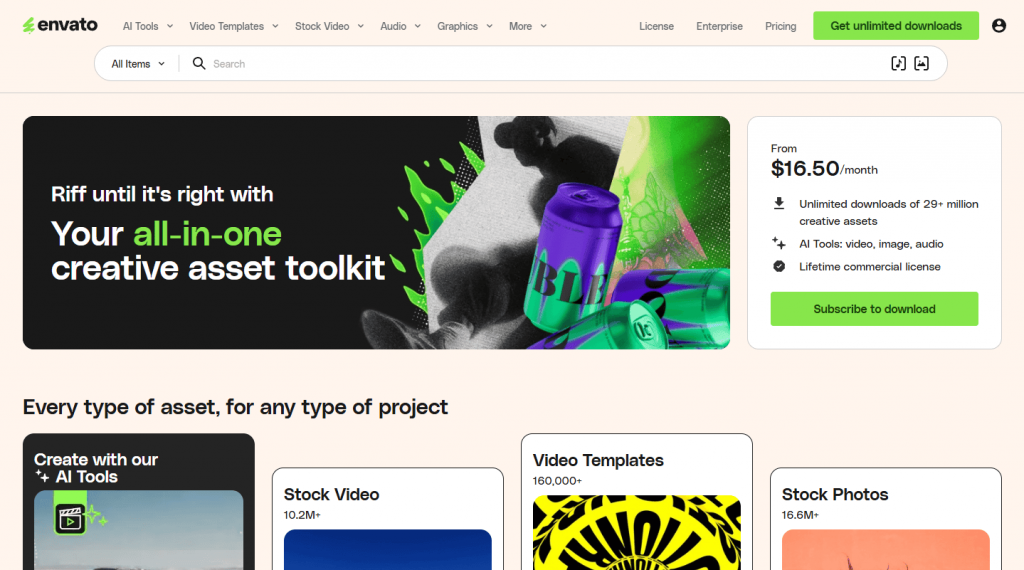
Envato Elements is a creative subscription platform rather than a dedicated music library. Its appeal is breadth — stock music is one of many asset types available under a single subscription that also includes:
- Templates — For video, web, and print
- Fonts — A substantial library of typefaces
- Photos — Stock photography in large volumes
- Video assets — Stock footage, motion graphics, and video templates
For creators or teams who regularly need assets across all of these categories, the value proposition is strong. The subscription covers an enormous range of creative inputs.
Pros
- Exceptional value for multi-asset creative needs
- Single subscription covers music, video, photos, templates, and fonts
- Large overall asset volume
- Regular new additions
Cons
- Music is one part of a much broader asset library rather than the main focus
- Licensing can be complex — specific terms apply to different asset types and uses
- Not ideal if music is your primary or only creative asset need
- Client licensing requires careful review
8. PremiumBeat
Subscription and Single Track Options
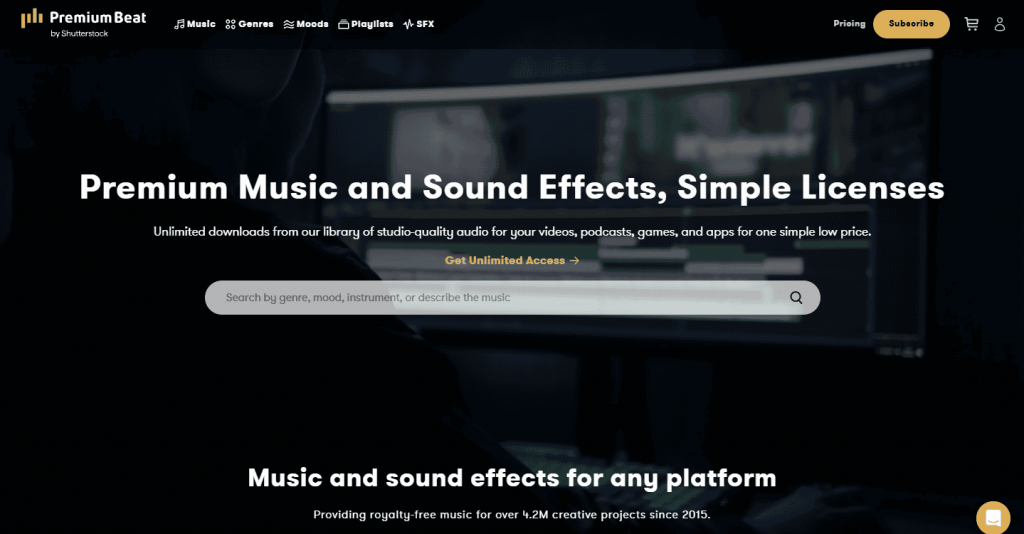
PremiumBeat, part of the Shutterstock family, now offers both subscription plans and per-track licensing. Subscription tiers — including unlimited download options — are available alongside the traditional per-track model, which means creators can choose the approach that suits their project volume. Subscription plans start from around $9.99/month billed annually.
Professional Music
The catalog is curated and professional. PremiumBeat doesn’t compete on volume — it competes on quality and licensing clarity. For creators who need music occasionally, or who need a specific track for a high-stakes project, the per-track model remains an option. For higher-volume users, the subscription tiers now make it a more competitive proposition.
Pricing
Monthly and annual subscription options, as well as per-track licensing. No lifetime option.
Pros
- High-quality, professionally curated catalog
- Subscription and per-track options now both available
- Strong for high-stakes, one-off projects
- Flexible license tiers to match specific use cases
Cons
- Catalog is not as large as some dedicated music-first competitors
- No lifetime membership option

9. Motion Array
Ideal for Video Editors
Motion Array, owned by Artlist since 2020, is built specifically for video editors, and the music library is one part of a broader platform that includes:
- Video templates — Premiere Pro and After Effects templates
- Plugins — Tools for video editing workflows
- Music — Royalty free tracks across standard genres
- Sound effects — Complementary sfx alongside the music catalog
For video editors who want a single subscription covering creative assets specifically relevant to their workflow, Motion Array’s bundled approach has real appeal. It’s less useful for creators whose needs extend beyond video editing.
Pros
- Strong value for video editors who use Premiere Pro or After Effects
- Bundled music, templates, plugins, and sfx under one subscription
- Clean user experience
- Regularly updated asset library
Cons
- Music is one part of a broader asset bundle rather than the main focus
- Less useful for creators who don’t work primarily in video editing software
- Agencies need a Business license
10. Tunetank
Budget-Friendly Alternative
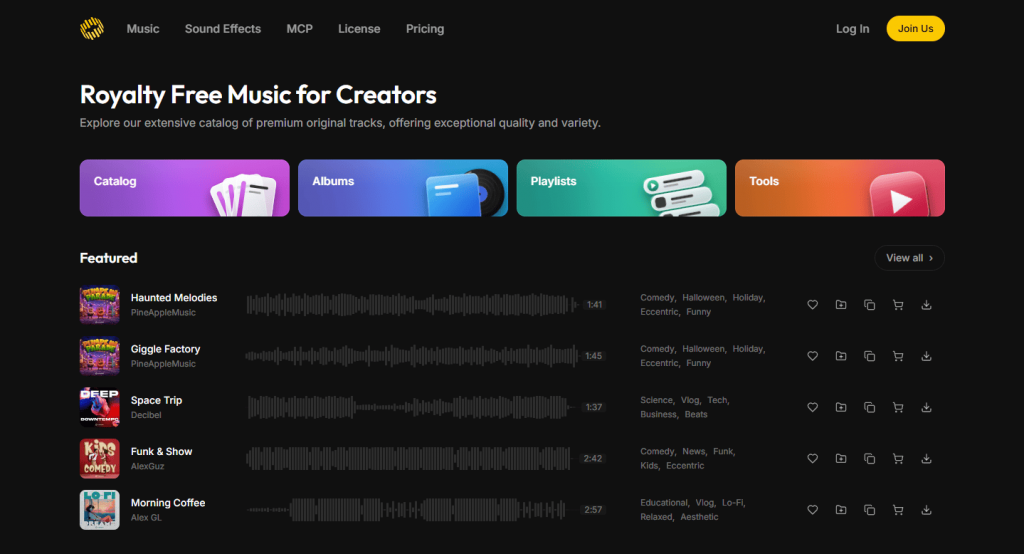
Tunetank positions itself as a lower-cost option in the royalty free music space. It offers a free tier for personal use, paid monthly and annual plans with unlimited downloads, and single-track licenses.
Strengths
The primary appeal is accessibility. For creators just starting out, or those with limited budgets, Tunetank provides a path to licensed music without significant upfront cost. Its Max plan covers client work and paid ads, and its Professional single-track license extends to broadcast, film and games.
Weaknesses
The free tier is limited to personal use and 3 downloads a month, and commercial and client work require the Max plan or a commercial single-track license.
11. Pixabay Music
Free Royalty Free Music
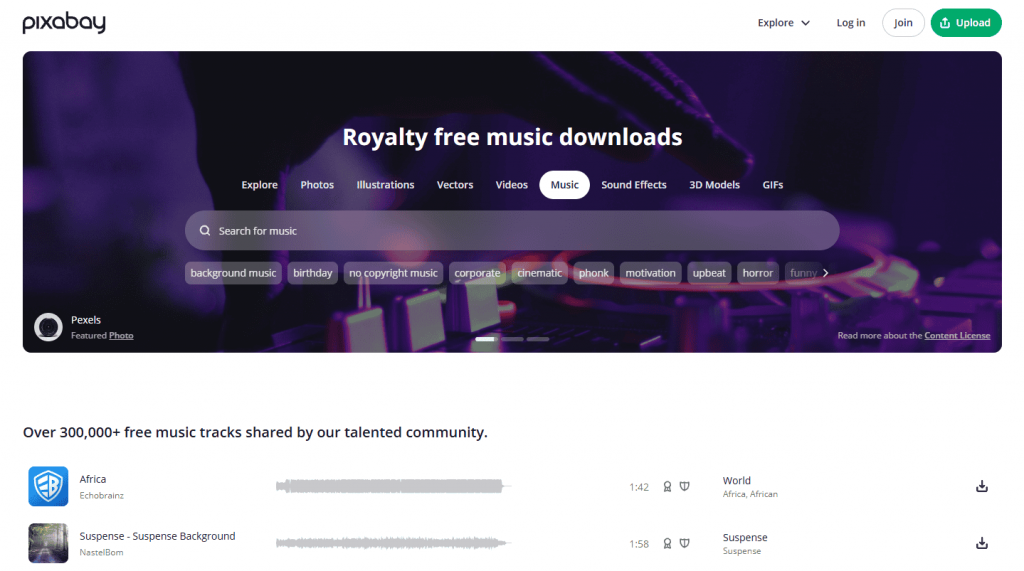
Pixabay Music is part of the broader Pixabay platform, which provides free stock assets across images, video, and audio. Music is offered under the Pixabay Content License, which allows commercial use, including client projects, as long as the music is part of a larger work. Attribution isn’t required.
The catalog is community-contributed, so quality varies from track to track, and finding production-ready material can take some searching. One caveat: some contributors register their tracks with YouTube’s Content ID, which can trigger claims even on licensed use. Pixabay marks those tracks and provides a license certificate for disputing claims.
For creators with zero budget, Pixabay Music is worth knowing about. For projects that need consistent quality, the limitations become apparent quickly.
12. YouTube Audio Library
Free Music for YouTube
Google’s YouTube Audio Library provides a free collection of music and sound effects specifically for use in YouTube videos. Tracks are either fully free to use with no attribution, or free to use with attribution to the original artist.
The library is curated for basic YouTube use, and the quality is passable for creators who are just starting out or who don’t yet have a budget for a paid subscription.
Who it’s best for: Beginner YouTubers building their first channel, students creating content for educational purposes, or anyone who needs background music immediately and without any cost. Terms vary by track, and many tracks are licensed for use in YouTube videos only, so check each track before using it elsewhere. It functions as a starting point rather than a long-term solution.
Best Royalty Free Music Sites by Creator Type
Choosing a library isn’t just about features in the abstract — it’s about what kind of work you actually do. Here’s how the platforms stack up by creator type.
Best for Independent and Documentary Filmmakers: TuneReel. A cinematic, film-score-style catalog, licensed per production so each film has its own license on record. Pro covers festival and online release for projects up to $100,000, and a Universal license covers streaming, TV and theatrical distribution.
Best for High-End Commercial and Branded Films: Musicbed. A premium, artist-driven catalog with per-project licenses that scale up to broadcast.
Best for Creators Who Want Music, Footage and Tools in One Subscription: Artlist. Music and sound effects alongside stock footage, templates, plugins and AI tools.
Best for Wedding Videographers: TuneReel. Emotional, cinematic music, clear client licensing on the Pro plan, and the lowest-priced paid client-work plan in this comparison.
Best for Freelancers and Small Studios on a Budget: TuneReel. Pro costs $159 a year or $19.99 a month and covers client work for organizations of up to 100 people.
Best for Podcasts: TuneReel. Pro covers podcasts of any size, and the catalog has strong ambient, jazz and acoustic options for intros and background beds.
Best for Churches and Nonprofits: TuneReel. The Pro plan covers non-profit use at a modest price. With no budget at all, Pixabay Music is free for commercial use.
Best for One-Off Projects: TuneReel. Single tracks cost $5 for personal use and $15 for commercial and client work. Epidemic Sound’s single-track licenses are another option.
Best for Lifetime Buyers: TuneReel and Audiio. TuneReel’s lifetime deal is currently $249; Audiio’s is currently $299 (list price $499).
Best for YouTubers: Epidemic Sound. Channel clearance is built in, the catalog is large, and sound effects are included.
Best for Social Media Managers: Epidemic Sound. Clearance across platforms and a sound effects library suited to short-form editing.
Best for Agencies and Larger Teams: Soundstripe. Its Enterprise plan is built for agencies and brands, with custom seats and broader coverage.
Best for Online Courses: Envato Elements. Music, slide templates, graphics and stock footage under one subscription.
Best for Video Editors Who Need More Than Music: Motion Array. Templates, plugins, footage and music bundled for Premiere Pro and After Effects users.
Subscription vs Buying Individual Tracks
The two dominant ways to access royalty free music work differently, and the right choice depends on how often you need music and what kinds of projects you’re producing.
Subscription Advantages
- Unlimited access to the full catalog, encouraging experimentation and variety
- Lower per-track cost for high-volume users
- Simpler workflow — find a track and use it without additional purchasing steps
- Catalog updates included without additional cost
- Predictable monthly or annual budget for business planning
Single Track Advantages
- No ongoing commitment — pay only when you need music
- No waste for low-volume creators who might not use a subscription enough to justify the cost
- Project-specific licensing that documents exactly what track was purchased for what use
- Useful for high-stakes projects where you want to own a specific license outright
When Each Makes Sense
Subscriptions make sense when you’re producing content regularly — multiple videos per month, ongoing campaigns, or consistent podcast production. The math works in your favor once you’re using more than a handful of tracks per month.
Single-track licenses make sense for occasional use, one-off projects, or creators who need a specific track for a specific purpose rather than ongoing access to a full library. For a filmmaker’s view of the choice, see our guide to finding music for an indie movie.
TuneReel’s pricing structure is one of the few that offers both subscription and individual licensing alongside a lifetime option — which means the decision doesn’t have to be permanent. Creators can start with a single-track purchase and move to a subscription if their volume increases.
How to Choose the Right Royalty Free Music Site
With a clearer picture of what’s available, the right choice comes down to a handful of practical considerations.
Budget — What can you realistically spend, and does that spending make sense against your actual project volume? A premium annual subscription is poor value if you’re only producing a few videos a year.
Music Quality — Does the catalog sound like the content you’re trying to make? It’s worth spending time with each platform’s demo tracks before committing. Quality differences are easier to hear than to describe. Our guide on how to find the right music for your video walks through the process.
Licensing Needs — What are you actually making? Personal YouTube content, business videos, client work, advertising, games, and podcasts all have different requirements. Libraries split coverage across different license types, so read the license terms for your primary use before you subscribe.
Client Work — If you produce content for paying clients, this deserves specific attention. Not every library covers third-party commercial use under its base subscription, and the implications of getting this wrong are serious.
Content Volume — How much music do you actually need each month? If the answer is a few tracks, a subscription may not be the most efficient option. If you’re going through dozens of tracks, unlimited access becomes essential.
Future Growth — Where is your work heading? A platform that suits your current needs but restricts the use cases you’re moving toward will create friction later. Choosing a library with broader coverage now can save a migration headache later.
Common Licensing Mistakes to Avoid
Music licensing is an area where assumptions tend to be expensive. These are the mistakes that come up most often.
Assuming royalty free means free. “Royalty free” refers to the absence of ongoing royalty payments per use — it doesn’t mean the music costs nothing. You typically pay once (per track or via subscription) and can then use the music without paying royalties each time it’s played. Free and royalty free are different things.
Ignoring commercial licenses. Using music licensed for personal use in content that promotes a business, product, or service is a common licensing violation. Commercial licensing typically costs more and needs to be obtained specifically.
Forgetting client licensing. Creating content for a paying client places additional demands on your license. Music cleared for your own projects may not automatically be cleared for work produced on behalf of someone else. Check before you deliver.
Using music outside the license scope. A license for online video doesn’t automatically cover broadcast television, film festivals, or podcast distribution. Each use case may require specific coverage.
Not checking broadcast rights. If your content is going to television, streaming platforms, or major online advertising campaigns, broadcast use may need additional clearances beyond a standard commercial license. This is worth verifying before production rather than after.
Frequently Asked Questions
What is royalty free music?
Royalty free music, often sold as stock music or production music, is music licensed under terms that allow the licensee to use it without paying ongoing royalties per play or broadcast. You pay once — either per track or through a subscription — and can use the music without incurring additional fees each time it plays. The music remains owned by its creators; “royalty free” describes the payment structure, not the ownership arrangement.
Is royalty free music actually free?
Not in most cases. “Royalty free” refers to the absence of per-use royalty payments, not to the absence of any cost. Most platforms charge for access, either through subscriptions or per-track purchases. Some platforms — like Pixabay Music and YouTube Audio Library — offer genuinely free access with varying restrictions and quality levels.
Can I monetize YouTube videos with royalty free music?
Generally yes, provided your license covers YouTube monetization. Platforms like Epidemic Sound use a Content ID whitelisting system that proactively prevents copyright claims. Other platforms require that the license terms explicitly permit monetized YouTube use. It’s worth verifying this before publishing. TuneReel’s licenses cover monetized content, and if a Content ID claim does appear, TuneReel resolves it on request.
Can I use royalty free music for client projects?
This depends entirely on the platform and the tier of license you hold. Many libraries distinguish between personal use and client or commercial work. If you’re producing content for a paying client, verify that your license explicitly covers third-party commercial use before delivering the project.
What happens if I cancel a subscription?
Policies vary significantly by platform. Most platforms allow you to retain the right to use content you downloaded and published before your subscription ended, but prohibit new downloads or new uses after cancellation. Read the specific cancellation terms before signing up, particularly if you’re producing work you’ll continue using long-term.
Is lifetime licensing worth it?
For creators who have found a library they’re satisfied with and who plan to produce content consistently over a long period, lifetime licensing typically offers strong long-term value. The break-even point against annual subscriptions is roughly one and a half to three years. Platforms offering this option — including TuneReel and Audiio — make it a viable long-term strategy rather than just a promotional offer.
Which royalty free music site has the best value?
Value depends on your use case. For filmmakers and freelancers who need client coverage, TuneReel offers the lowest-priced paid client-work plan in this comparison, along with single-track and lifetime options. For pure YouTube and social media use, Epidemic Sound is strong. For premium branded and commercial work, Musicbed stands out, and Artlist offers the most in a single subscription.
Can I use royalty free music on TikTok and Instagram?
This is platform-dependent. Social media licensing can be complex because TikTok and Instagram have their own content management systems that may flag music regardless of your license. Check whether your chosen platform specifically addresses TikTok and Instagram use. TuneReel’s licenses cover social media use: Basic for channels under 10,000 subscribers, Pro for larger channels and client work.
Can I use royalty free music in podcasts?
Most libraries cover podcast use, but it’s worth confirming rather than assuming. Podcast-specific licensing needs to cover distribution across directories like Spotify, Apple Podcasts, and others. Some platforms have limitations around podcast use within their base subscription tiers.
Can I use royalty free music in games?
Interactive use — embedding music in games, apps, or other interactive media — isn’t universally covered in royalty free licenses, and it’s a use case that requires specific confirmation. Check each platform’s terms for interactive or in-game use; some cover it only on higher tiers or by quote.
Which music site has the easiest licensing?
Ease of licensing is partly about how clearly the terms are written and partly about how broadly the license covers common use cases without requiring additional steps. TuneReel and Artlist both score well on licensing simplicity. Musicbed’s per-use license structure is clear, though more granular.
What’s the difference between royalty free and copyright free?
Copyright free music is music in the public domain — either because copyright has expired or because the creator explicitly waived all rights. It can be used freely without any license or payment. Royalty free music is still under copyright, but the licensing terms allow use without ongoing royalty payments. The vast majority of music on professional platforms is royalty free, not copyright free.
Final Verdict
After evaluating these royalty-free music sites across music quality, catalog depth, licensing clarity, search functionality, and pricing flexibility, here’s where each one fits best:
| Library | Best For |
|---|---|
| TuneReel | Best for Filmmakers and Cinematic Projects |
| Artlist | Best All-in-One Platform for Video Creators |
| Epidemic Sound | Best for YouTubers and Social Creators |
| Soundstripe | Best for Teams and Agencies |
| Musicbed | Best for Premium Commercial Work |
| Audiio | Best for Lifetime Buyers |
| Envato Elements | Best for Mixed Creative Assets |
| PremiumBeat | Best for Flexible Track Licensing |
| Motion Array | Best for Video Editors |
| Tunetank | Best Budget Alternative |
| Pixabay Music | Best Free Option |
| YouTube Audio Library | Best for Beginner Creators |
The right choice depends on what you’re making, how often you need music, and what your licensing requirements look like. Most creators will find that one of the subscription platforms makes more sense than building a library track by track — and within the subscription category, the royalty-free music platform whose licensing most cleanly covers your use cases is the one worth paying for.
This guide is published by TuneReel, so weigh our pick accordingly. For filmmakers who want cinematic music, licensing organized around their productions, and pricing that respects an indie budget, TuneReel is worth exploring. We built it for exactly that work.
Pairing the right music with your content is only one part of a strong production. If you’re building out your video workflow, our guides on the best video editing software for YouTube, sound design in video editing, and color grading in films are worth a read.
This guide is general information, not legal advice.